
Undergraduate Dissertation Methodology: How to Write It (With Example)
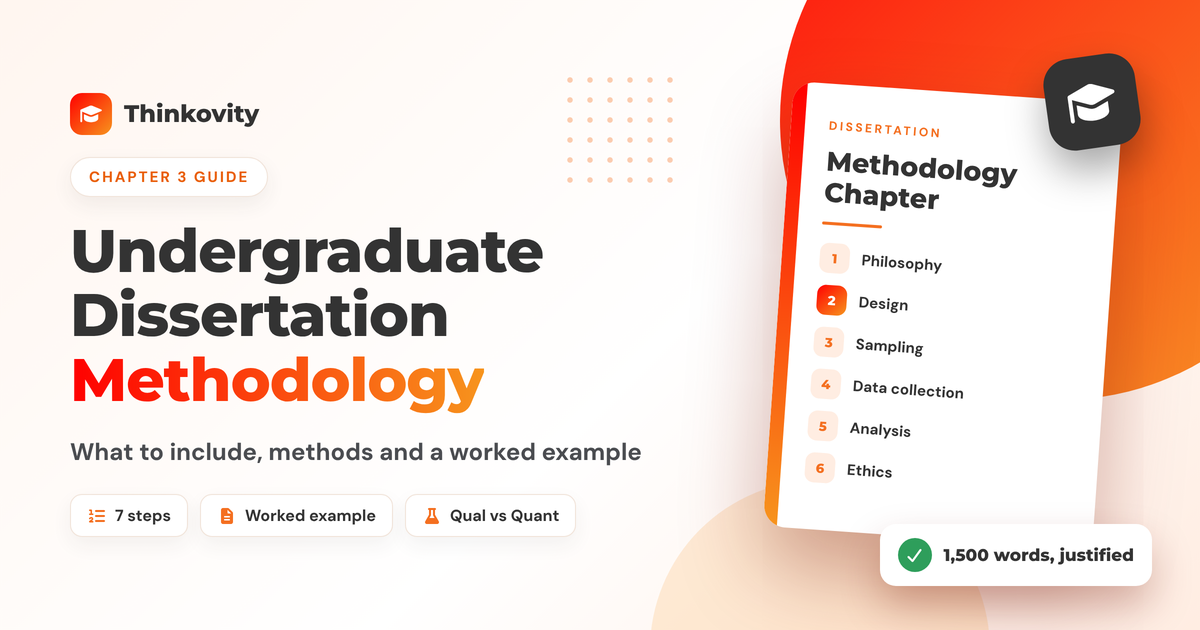
An undergraduate dissertation methodology explains how you carried out your research and why. It covers your research philosophy, approach, design, sampling, data collection, data analysis, ethics and limitations. It is usually 10 to 15% of the word count, about 1,000 to 1,500 words in a 10,000-word dissertation.
The methodology is where examiners decide whether your findings can be trusted. Done well, it proves your research was planned, justified and ethical. Done badly, it reads like a list of things you did with no reasons.
This guide shows what to include, how to choose between qualitative, quantitative and mixed methods, how to explain sampling, data collection and analysis, and how to write each section. It also includes a worked methodology example. If you are still planning the whole project, start with our undergraduate dissertation guide first.
- What is a dissertation methodology?
- Methodology vs methods
- What to include (chapter structure)
- Research philosophy and approach
- Qualitative vs quantitative vs mixed methods
- Research design and strategy
- Sampling
- Data collection
- Data analysis
- Validity, reliability and trustworthiness
- Research ethics
- How to write it in 7 steps
- Methodology example
- Common mistakes and checklist
- FAQs
What Is a Dissertation Methodology?
The methodology is the chapter of your dissertation that explains how you did your research and why you did it that way. It tells the reader which approach you chose, who or what you studied, how you collected and analysed the evidence, and how you kept the study ethical and trustworthy. In a typical 10,000-word undergraduate dissertation it is chapter 3, straight after the literature review and before the findings.
Examiners read this chapter to decide whether your results can be trusted. A clear, justified methodology shows that your conclusions rest on sound research rather than guesswork. It is also one of the easiest chapters to lose marks in, because many students describe what they did without explaining why. This guide is part of our complete undergraduate dissertation guide, and goes deeper on this one chapter.
Methodology vs Methods: What Is the Difference?
Methodology is your overall research strategy and the reasoning behind it. Methods are the specific tools and techniques you use to gather and analyse data. Your chapter needs both, and the justification is what earns the marks.
| Methodology | Methods | |
|---|---|---|
| What it is | The overall approach and the reasons for it | The practical tools and techniques |
| Answers the question | “Why did I choose this approach?” | “What exactly did I do?” |
| Examples | Quantitative, deductive, positivist approach | Online questionnaire, structured interview, SPSS regression |
| Where it appears | Philosophy, approach and design sections | Data collection and analysis sections |
What to Include in an Undergraduate Dissertation Methodology
Most universities expect the sections below. Your course may reorder or combine them, so check your handbook and marking rubric. As a guide, the whole chapter is about 15% of your total word count.
| Section | What to write | Approx. words (of 1,500) |
|---|---|---|
| 1. Introduction to the chapter | Restate the research question and aim, and outline what the chapter covers | 100 |
| 2. Research philosophy and approach | State and justify your philosophy (for example positivism or interpretivism) and approach (deductive or inductive) | 200 |
| 3. Research design and strategy | Explain the overall design, such as a survey, case study, interviews or secondary data | 200 |
| 4. Sampling | Define the population, sampling technique and sample size, with reasons | 200 |
| 5. Data collection | Describe the instrument (questionnaire, interview guide), how you piloted and distributed it | 250 |
| 6. Data analysis | Name the technique (thematic analysis, regression) and the software | 200 |
| 7. Validity, reliability and trustworthiness | Show how you made the findings credible | 100 |
| 8. Ethical considerations | Consent, anonymity, data protection and approval | 150 |
| 9. Limitations and summary | State honest limitations and summarise the chapter | 100 |
A literature-based dissertation replaces sampling and data collection with a search strategy, inclusion and exclusion criteria, and a method for synthesising the sources.
Research Philosophy and Approach
Research philosophy
Your philosophy is your view of what counts as knowledge and how it can be found. Most undergraduate dissertations use one of three:
- Positivism: knowledge comes from measurable, observable facts. It usually leads to quantitative research such as surveys and statistics.
- Interpretivism: knowledge comes from understanding people’s views and experiences. It usually leads to qualitative research such as interviews.
- Pragmatism: the best method is whichever answers the question. It often supports mixed methods.
Say which one you follow in one or two sentences and explain why it suits your research question. Do not just list all three.
Research approach: deductive or inductive?
| Deductive | Inductive | |
|---|---|---|
| Starts with | An existing theory or hypothesis | Data and observations |
| Aim | Test whether the theory holds | Build a theme, pattern or theory |
| Usually paired with | Quantitative, positivist research | Qualitative, interpretivist research |
| Example | Testing whether influencer trust predicts purchase intention | Exploring why students choose certain study apps |
Many business and social science dissertations organise these choices with the research onion by Saunders, Lewis and Thornhill. It lays out your decisions in layers, from philosophy and approach to strategy, choices, time horizon, and techniques. If your university uses it, structure your chapter in the same order.
Qualitative vs Quantitative vs Mixed Methods
This is the biggest choice in your methodology. Pick the approach that best answers your research question, then justify it.
| Quantitative | Qualitative | Mixed methods | |
|---|---|---|---|
| Data type | Numbers and statistics | Words, themes and meanings | Both |
| Typical tools | Questionnaires, experiments, secondary datasets | Interviews, focus groups, open-ended responses | Survey followed by interviews |
| Best for | Measuring, comparing and testing relationships | Exploring experiences, reasons and opinions | Explaining statistical results in depth |
| Analysis | Descriptive statistics, correlation, regression (SPSS, Excel, R) | Thematic or content analysis (NVivo, manual coding) | Statistics plus thematic analysis |
| Main risk | Shallow explanations | Small, non-generalisable samples | Too big for an undergraduate word limit |
Mixed methods can strengthen a study, but it doubles the work. For a 10,000-word undergraduate dissertation, a single well-executed method is usually safer.
Research Design and Strategy
Your research design is the overall plan for answering your question. Common choices are:
| Strategy | What it involves | Suits |
|---|---|---|
| Survey | A questionnaire completed by many people | Measuring attitudes, behaviour or satisfaction |
| Interviews | One-to-one conversations, structured or semi-structured | Understanding experiences in depth |
| Case study | In-depth study of one organisation, event or group | Business, education and health research |
| Experiment | Testing the effect of a change under controlled conditions | Psychology, science and computing |
| Secondary data analysis | Analysing existing datasets, reports or company accounts | Finance, economics and marketing |
| Systematic or literature review | Searching, selecting and synthesising published research | Law, health and education |
Also state your time horizon. Most undergraduate studies are cross-sectional, meaning data is collected once, because a longitudinal study takes too long for one academic year.
Sampling: Who Will You Study?
You cannot study everyone, so you choose a sample from your target population. Explain your population, your sampling technique and your sample size, and why each is appropriate.
| Type | Technique | How it works | Common use |
|---|---|---|---|
| Probability | Simple random | Everyone has an equal chance of selection | Large surveys with a full list of people |
| Probability | Stratified | Random selection within subgroups | Making sure groups are fairly represented |
| Non-probability | Convenience | Participants who are easy to reach | Most undergraduate surveys |
| Non-probability | Purposive | Participants chosen for specific knowledge or experience | Interviews and case studies |
| Non-probability | Snowball | Participants recruit others | Hard-to-reach groups |
As a rough guide, undergraduate surveys often have around 100 to 300 respondents, and interview studies about 8 to 15 participants, but confirm what your supervisor expects. Always admit that non-probability samples limit how far you can generalise your results.
Data Collection Methods
Describe your instrument and exactly how you used it. A reader should be able to picture the process.
- Questionnaires: state the number of questions, the scale (for example a five-point Likert scale), where the items came from, how you piloted it with a few people, and how you distributed it (for example Google Forms or Qualtrics).
- Interviews: say whether they were structured, semi-structured or unstructured, how long they lasted, how they were recorded and transcribed, and how you built the interview guide.
- Secondary data: name the source, the time period, the variables and why the data is reliable.
- Literature-based work: list the databases searched, your search terms, the date range, and your inclusion and exclusion criteria.
Also state the dates your data was collected. Anything you changed after piloting is worth mentioning, because it shows careful research.
Data Analysis Methods
Explain how you turned raw data into findings. Name the technique and the software, and justify your choice.
| Data | Technique | Common tools |
|---|---|---|
| Survey numbers | Descriptive statistics, correlation, regression, t-tests, chi-square | SPSS, Excel, R, Jamovi |
| Interview or open-text data | Thematic analysis (many students follow the six phases of Braun and Clarke) or content analysis | NVivo, manual coding in Word or Excel |
| Secondary financial data | Ratio analysis, trend analysis, regression | Excel, Stata, R |
| Published studies | Narrative or thematic synthesis | Spreadsheet or reference manager |
The six phases of thematic analysis are: familiarise yourself with the data, generate initial codes, search for themes, review themes, define and name themes, and produce the report. Briefly describing the phases you followed makes your qualitative analysis look systematic.
Validity, Reliability and Trustworthiness
Show the reader why your findings can be believed.
- Quantitative research uses validity (does the question measure what it claims to?) and reliability (would it give consistent results?). A common check is Cronbach’s alpha, where 0.7 or above is usually treated as acceptable.
- Qualitative research uses trustworthiness, often described by Lincoln and Guba as credibility, transferability, dependability and confirmability. Methods include member checking, keeping an audit trail and reflecting on your own bias.
Research Ethics
If your study involves people, your university will expect you to follow ethical rules and to get approval before you collect any data. In your methodology, explain how you:
- Obtained approval from your university ethics committee
- Gave participants an information sheet and obtained informed consent
- Protected anonymity and confidentiality
- Stored data securely and in line with UK GDPR and the Data Protection Act 2018
- Allowed participants to withdraw at any time
- Took extra care with vulnerable groups or sensitive topics
Attach the information sheet, consent form and ethics approval letter in your appendices.
How to Write Your Methodology in 7 Steps
- Re-read your research question and objectives. Every choice you make must help answer them.
- Check your handbook. Note the required sections, word limit, referencing style and any model such as the research onion.
- Choose your approach. Decide on quantitative, qualitative or mixed methods, and note the reasons.
- Plan your sampling and data collection. Decide who, how many and how, then pilot your instrument.
- Get ethical approval before you contact a single participant.
- Write each section in the past tense. For every choice, use this pattern: what you did, why you did it, and what source supports it. Cite methodology textbooks such as Saunders et al. and Bryman.
- Edit for justification and limitations. Check that no choice is stated without a reason, then add honest limitations.
Many students write the methodology before collecting data, as a plan in the proposal, then update it to the past tense once the data is collected.
Not sure which method fits your question?
Our subject experts give one-to-one guidance on choosing, justifying and writing up your dissertation methodology.
Undergraduate Dissertation Methodology Example
This extract continues the example in our undergraduate dissertation guide: The Impact of Instagram Influencer Marketing on Gen Z Fashion Purchase Intentions in the UK. Use it to see the style and the level of justification, not as text to copy. The details are illustrative.
Example: research philosophy and approach
This study adopts a positivist philosophy, because it seeks to measure the relationship between perceived influencer credibility and purchase intention using observable, quantifiable data (Saunders, Lewis and Thornhill, 2019). A deductive approach was used, as hypotheses were developed from Source Credibility Theory and then tested against the survey data. An interpretivist philosophy was rejected because the aim was to test relationships across a wide sample rather than to explore individual experiences in depth.
Example: research design and sampling
A mono-method quantitative, cross-sectional survey was chosen because it allows data on attitudes to be collected from a large group within the time available. The target population was UK-based consumers aged 18 to 25 who follow fashion influencers on Instagram. Convenience sampling was used, with the questionnaire shared through university groups and social media. A total of 152 valid responses were obtained. Although convenience sampling limits generalisability, it was the most practical option within the time and resources of an undergraduate project.
Example: data collection and analysis
Data was collected through an online questionnaire built in Google Forms and open for three weeks. Constructs were measured with five-point Likert scales adapted from validated scales in earlier studies. The questionnaire was piloted with ten respondents, and two ambiguous items were reworded. Responses were analysed in SPSS using descriptive statistics, Pearson correlation and multiple regression. Cronbach’s alpha values above 0.7 for each construct indicated acceptable reliability.
Example: ethics
Ethical approval was granted by the university before data collection began. Participants received an information sheet, gave informed consent before answering, and could withdraw at any time. No names or contact details were collected, and the data was stored on a password-protected university account in line with UK GDPR.
Notice that every choice follows the same pattern: what was done, why it was chosen, and what the limitation is.
Common Methodology Mistakes and Final Checklist
| Mistake | How to avoid it |
|---|---|
| Describing without justifying | After every choice, add “because” and a citation |
| Choosing a method because it is easy | Choose the method that best answers your research question |
| Copying the research onion without explaining it | Explain each layer in your own words and apply it to your study |
| Sample too small or poorly described | State the population, technique and size, and admit the limits |
| Ignoring ethics | Get approval first and describe consent, anonymity and data storage |
| No limitations | Honest limitations show critical awareness and earn marks |
| Writing in the future tense after the study | Use the past tense for what you actually did |
Methodology checklist
- The chapter links clearly back to the research question and objectives
- Philosophy and approach are stated and justified
- Design, sampling and sample size are explained
- Instrument, piloting and data collection steps are described
- Analysis technique and software are named and justified
- Validity, reliability or trustworthiness is addressed
- Ethical approval, consent and data protection are covered
- Limitations are stated honestly
- Every choice has a reason and a citation
- The chapter is within your word allowance and in the past tense
Frequently Asked Questions
What is the methodology in an undergraduate dissertation?
The methodology is the chapter that explains how you carried out your research and why you chose that approach. It covers your research philosophy, approach, design, sampling, data collection, data analysis, ethics and limitations, so another researcher could repeat your study.
How long should an undergraduate dissertation methodology be?
A methodology chapter is usually 10 to 15% of the total word count, which is about 1,000 to 1,500 words in a 10,000-word dissertation. Some courses allow up to 2,000 words, so check your handbook.
What is the difference between methodology and methods?
Methodology is the overall strategy and the reasons behind your choices, such as why a survey suits your question. Methods are the specific tools you used, such as an online questionnaire analysed in SPSS. A strong chapter explains both.
Should I use qualitative or quantitative research?
Use quantitative research to measure, compare or test relationships with numbers, and qualitative research to explore experiences, opinions or reasons in depth. Choose whichever method best answers your research question, not the one that looks easier.
How many participants do I need for my dissertation?
There is no universal number. Undergraduate surveys often use around 100 to 300 respondents, while interview studies commonly use about 8 to 15 participants. Your supervisor can confirm what is acceptable for your course and method.
Do I need ethical approval for my dissertation?
If you collect data from people, such as surveys or interviews, you almost always need ethical approval from your university before you begin. Literature-based dissertations usually need little or none, but you should confirm with your supervisor.
Can I write a methodology without primary research?
Yes. For a literature-based or secondary data dissertation, your methodology explains how you searched for sources, your inclusion and exclusion criteria, and how you analysed and synthesised the evidence.
What tense should the methodology be written in?
Write it mostly in the past tense, because it describes what you did, for example “A questionnaire was distributed to 152 respondents.” Follow your university’s guidance on first person and passive voice.
What is the research onion?
The research onion is a framework by Saunders, Lewis and Thornhill that shows methodology decisions as layers: philosophy, approach, strategy, choices, time horizon, and techniques and procedures. Many business and social science dissertations use it to organise the chapter.
Can I get help writing my dissertation methodology?
Yes. Your supervisor and university library are the first places to go. You can also get one-to-one guidance on choosing and justifying your method, plus feedback on your draft, from academic support services such as Thinkovity. Always follow your university’s academic integrity policy.
Conclusion
A strong methodology answers one question for every choice you made: why? Match your approach to your research question, describe your sampling, data collection and analysis clearly, address ethics and quality, and be honest about limitations. Then move on to your findings with confidence.
Next in the series: plan your full dissertation structure and timeline, or keep reading the guides below.
Related dissertation guides
Need expert dissertation methodology help?
Thinkovity’s subject experts support UK undergraduates with choosing a research design, justifying methods, planning sampling and ethics, and giving feedback on your methodology chapter draft. Get a free quote today and save 20% on your order.