
Write a Winning Undergraduate Dissertation with Example
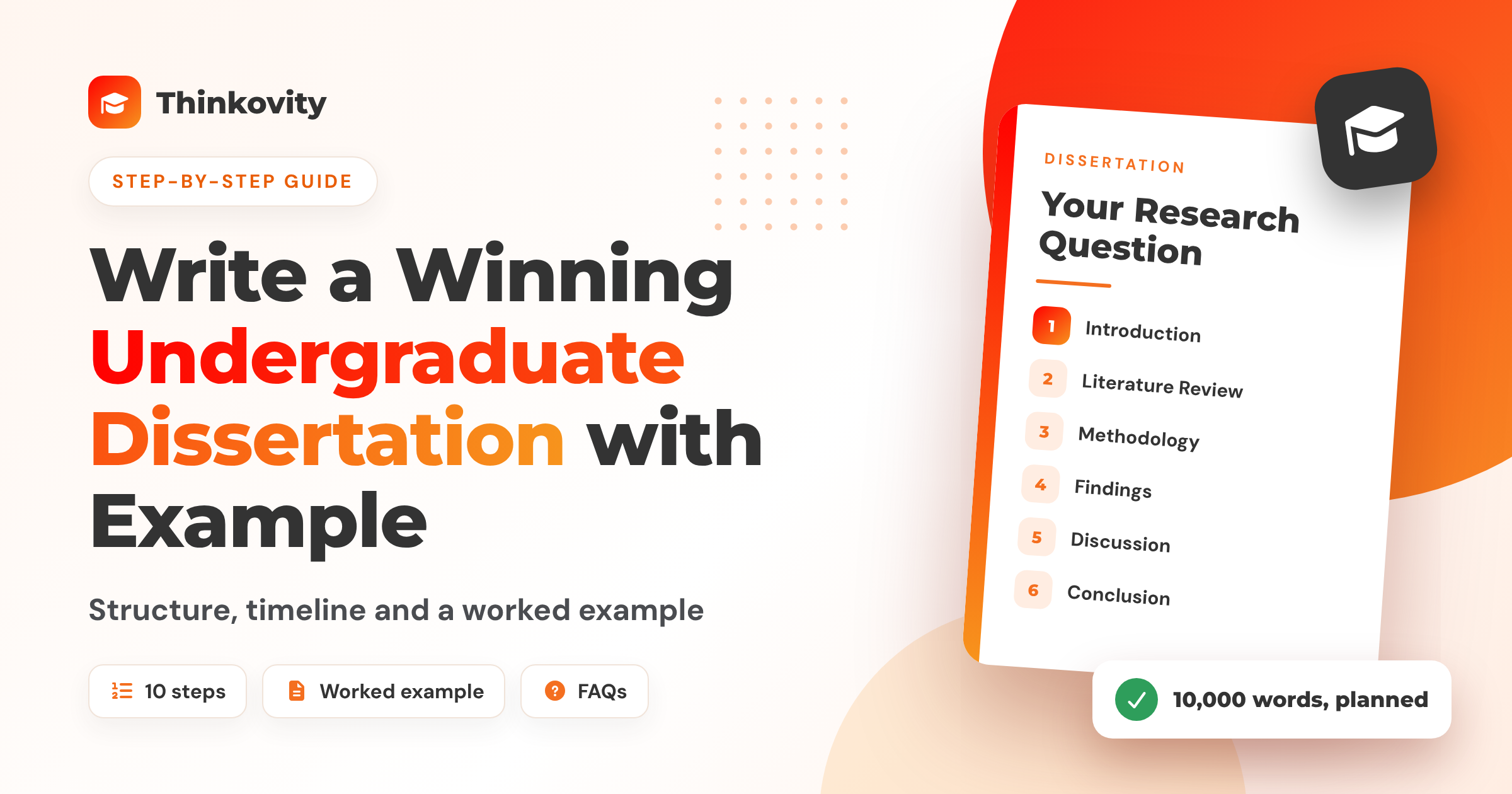
To write an undergraduate dissertation, choose a narrow, feasible, and interesting topic, write a clear set of research questions, review the literature, pick a suitable research method, collect and analyse your data, and then write up your findings, discussion, and conclusion. Most UK undergraduate dissertations are 8,000 to 12,000 words and are written over 6 to 8 months in the final year.
Your dissertation is usually the biggest single piece of work in your degree. It can feel overwhelming, but it becomes manageable once you break it into clear stages.
In this guide, you will learn what an undergraduate dissertation is, how it differs from a thesis or an essay, the standard structure with a word count for each chapter, how to write it in 10 practical steps, and what a worked example looks like.
What Is an Undergraduate Dissertation?
An undergraduate dissertation is an independent research project written in the final year of a bachelor’s degree. You choose a topic, ask a specific research question, and answer it using existing literature, your own data, or both. In the UK it is usually 8,000 to 12,000 words, and the exact limit is set by your university and course.
Unlike a regular assignment, nobody hands you the question. You set it yourself, plan the research and manage your own time. A supervisor guides you, but the ideas and the writing are yours.
What is the purpose of a dissertation?
A dissertation shows that you can:
- Find a gap or problem worth investigating in your subject
- Read and critically evaluate academic sources
- Choose and justify a research method
- Analyse evidence and draw reasoned conclusions
- Write a long, well-structured academic document with accurate referencing
Types of undergraduate dissertation
| Type | What you do | Common in |
|---|---|---|
| Empirical | Collect your own data through surveys, interviews, experiments or observation | Business, psychology, nursing, social sciences |
| Secondary data | Analyse existing datasets, reports or company accounts | Finance, economics, marketing |
| Literature-based (desk research) | Review and synthesise published research to answer a question | Law, education, health and social care |
| Practical or project-based | Build or test something, then evaluate it | Computing, engineering, design |
Your course handbook will tell you which types are allowed and whether you need ethical approval before collecting data.
Dissertation vs Thesis vs Essay: What Is the Difference?
In the UK, a dissertation is usually the final project of a bachelor’s or master’s degree, while a thesis usually means a longer doctoral (PhD) project. In the US the terms are often reversed. An essay is much shorter and answers a question someone else has set.
| Feature | Essay | Undergraduate dissertation | Thesis (UK PhD) |
|---|---|---|---|
| Typical length | 1,500 to 4,000 words | 8,000 to 12,000 words | 80,000 to 100,000 words |
| Who sets the question | Your lecturer | You, agreed with your supervisor | You |
| Original research | Rarely | Often a small study or focused review | Always, a new contribution to knowledge |
| Time to complete | 1 to 4 weeks | 6 to 8 months | 3 to 4 years |
| Structure | Introduction, body, conclusion | Chapters, from introduction to conclusion | Chapters, plus a viva (oral exam) |
Undergraduate Dissertation Structure (With Word Count)
Most undergraduate dissertations follow the same structure: introduction, literature review, methodology, findings, discussion and conclusion. Here is a typical word split for a 10,000-word dissertation. Always check your own handbook, because some courses combine chapters or exclude the reference list from the word count.
| Section | Share of words | Words (10,000 total) | What it does |
|---|---|---|---|
| Title page, abstract, contents | Usually not counted | 200 to 300 (abstract) | Summarises the whole project on one page |
| 1. Introduction | 10% | 1,000 | Gives background, the problem, research question, aims and objectives |
| 2. Literature review | 25 to 30% | 2,500 to 3,000 | Evaluates existing research and shows the gap your study fills |
| 3. Methodology | 15% | 1,500 | Explains and justifies how you collected and analysed data, and ethics |
| 4. Findings or results | 15 to 20% | 1,500 to 2,000 | Presents what you found, with tables, charts or themes |
| 5. Discussion | 15 to 20% | 1,500 to 2,000 | Interprets the findings against the literature |
| 6. Conclusion and recommendations | 10% | 1,000 | Answers the research question, states limitations and next steps |
| References and appendices | Usually not counted | n/a | Lists every source and holds surveys, transcripts and consent forms |
A literature-based dissertation replaces the findings chapter with thematic analysis chapters, but it still needs an introduction, a clear method for selecting sources, and a conclusion.
How to Write an Undergraduate Dissertation in 10 Steps
Follow these 10 steps in order. Each step builds on the one before, so it pays to get the early steps right.
- Read your dissertation handbook first. Note the word limit, deadline, referencing style (Harvard, APA 7, OSCOLA), required chapters, marking criteria and ethics rules. Most lost marks come from ignoring the brief.
- Choose a focused topic. Pick something you genuinely find interesting, that fits your course, and that has enough published research. Narrow it down by place, time, group or industry. “Social media marketing” is too broad; “Instagram influencer marketing and Gen Z fashion purchases in the UK” is workable.
- Write a clear research question and objectives. Your research question is the single question your dissertation answers. Support it with 3 or 4 objectives that start with verbs such as identify, examine, evaluate and recommend.
- Write a short research proposal. Many universities ask for a 1,000 to 2,000-word proposal covering your topic, question, initial literature, method and timeline. Agree it with your supervisor before you start collecting data.
- Conduct the literature review. Search Google Scholar, your library database, JSTOR and ScienceDirect. Prioritise peer-reviewed journal articles from the last 5 to 10 years. Group sources by theme, compare authors, and end by stating the gap your study addresses. Keep references organised from day one with Zotero, Mendeley or EndNote.
- Choose and justify your methodology. Decide between qualitative (interviews, focus groups), quantitative (surveys, statistics) or mixed methods. Explain your sampling, data collection and analysis method, such as thematic analysis or regression. Get ethical approval before you contact any participants.
- Collect and analyse your data. Stick to your plan, record everything, and store data securely. Use NVivo for qualitative coding, or SPSS, Excel or R for statistics.
- Write the chapters, not necessarily in order. Many students write the methodology first, then the literature review, findings and discussion. Write the introduction and abstract last, when you know exactly what you found.
- Link your discussion back to the literature. Show where your findings agree with or challenge earlier research, and explain why. This critical analysis is what separates a 2:1 from a first.
- Edit, proofread and check references. Leave at least two weeks to revise. Check that every in-text citation is in your reference list, the formatting matches your handbook, and you are under the word limit. Run a final plagiarism check before submitting.
Stuck on a step?
Our subject experts give one-to-one guidance on topics, proposals, literature reviews and methodology.
Undergraduate Dissertation Example
Here is a worked example from a BA (Hons) Business Management student. Use it to see how the parts fit together, not as text to copy. The findings below are illustrative.
Example title
The Impact of Instagram Influencer Marketing on Gen Z Fashion Purchase Intentions in the UK
Research question
To what extent does Instagram influencer marketing influence the fashion purchase intentions of Gen Z consumers (aged 18 to 25) in the UK?
Research objectives
- To review existing literature on influencer marketing, source credibility and purchase intention.
- To identify which influencer characteristics (trustworthiness, expertise, attractiveness) Gen Z consumers value most.
- To examine the relationship between perceived influencer credibility and purchase intention.
- To recommend how UK fashion brands can use influencer partnerships more effectively.
Example abstract (about 200 words)
Influencer marketing has become a central part of fashion brand strategy, yet evidence on how it shapes the buying decisions of UK Gen Z consumers remains limited. This study examines the extent to which Instagram influencer marketing influences the fashion purchase intentions of consumers aged 18 to 25 in the UK. Drawing on Source Credibility Theory, the research adopted a quantitative approach. An online survey was completed by 152 respondents, selected through convenience sampling, and the data were analysed in SPSS using correlation and multiple regression. The findings indicate that perceived trustworthiness had the strongest positive relationship with purchase intention, followed by expertise, while attractiveness had a weaker effect. Respondents also reported lower trust in posts that did not clearly disclose paid partnerships. The study concludes that credibility, rather than follower count, drives purchase intention among UK Gen Z consumers. It recommends that fashion brands prioritise long-term partnerships with relevant micro-influencers and transparent disclosure. Limitations include the non-probability sample and the focus on a single platform, and future research could compare Instagram with TikTok.
Example chapter outline
| Chapter | Key content in this example | Words |
|---|---|---|
| 1. Introduction | Growth of influencer marketing in UK fashion; why Gen Z matters; research question and objectives | 1,000 |
| 2. Literature review | Source Credibility Theory; influencer trust and expertise; disclosure and ASA rules; the research gap | 3,000 |
| 3. Methodology | Positivist philosophy; online survey of 152 respondents; Likert scales; SPSS regression; ethics and consent | 1,500 |
| 4. Findings | Respondent profile; descriptive statistics; correlation and regression results with tables | 1,800 |
| 5. Discussion | Findings compared with earlier studies; why trust outweighs follower count | 1,700 |
| 6. Conclusion | Answer to the research question; recommendations for brands; limitations; future research | 1,000 |
Example introduction opening
UK fashion brands are spending more of their marketing budgets on social media influencers, and Gen Z consumers spend more time on Instagram and TikTok than on any traditional media. Yet it remains unclear whether an influencer’s post actually changes what a young consumer decides to buy. This dissertation investigates that question by examining how the perceived credibility of Instagram influencers affects the purchase intentions of UK consumers aged 18 to 25.
Notice how the opening moves from the wider context to the specific problem, and ends with what the dissertation will do. Your introduction should follow the same funnel shape.
Common Dissertation Mistakes (and How to Avoid Them)
Most low marks come from a few avoidable mistakes:
| Mistake | How to avoid it |
|---|---|
| Topic too broad | Narrow it by country, sector, group or time period until one question can answer it |
| Describing sources instead of evaluating them | Compare authors, point out weaknesses and say what the evidence means for your question |
| Methodology not justified | Explain why your method suits your question, and why you rejected the alternatives |
| Discussion repeats the findings | Interpret the results and link each one back to the literature review |
| Conclusion introduces new material | Only answer the research question, summarise, and give limitations and recommendations |
| Inconsistent or missing references | Use a reference manager and follow one style exactly |
| Leaving everything to the last month | Set chapter deadlines and send drafts to your supervisor early |
7 tips for a first-class dissertation
- Make your research question specific and answerable within the word limit.
- Build a clear argument that runs from the introduction to the conclusion.
- Use recent, peer-reviewed sources, not mainly websites or textbooks.
- Apply at least one relevant theory or model, such as Source Credibility Theory or Porter’s Five Forces.
- Be honest about limitations; examiners reward critical self-awareness.
- Use tables and figures to present data, and always discuss them in the text.
- Act on your supervisor’s feedback and keep a record of meetings.
Dissertation Timeline and Submission Checklist
A typical undergraduate dissertation runs from about September to April of the final year. Adjust the months to match your own deadline.
| Month | Milestone |
|---|---|
| Month 1 (September) | Read the handbook, shortlist topics, meet your supervisor |
| Month 2 (October) | Finalise the research question and submit the proposal |
| Month 3 (November) | Write the literature review; apply for ethical approval |
| Month 4 (December) | Write the methodology; prepare surveys or interview questions |
| Month 5 (January) | Collect data |
| Month 6 (February) | Analyse data; write the findings chapter |
| Month 7 (March) | Write the discussion, conclusion, introduction and abstract |
| Month 8 (April) | Edit, proofread, check references and submit |
Final submission checklist
- Title page, abstract and contents page are complete
- Research question is answered clearly in the conclusion
- Every objective is addressed in the findings or discussion
- Word count is within the limit (including or excluding what your handbook says)
- All in-text citations match the reference list, in the right style
- Tables and figures are numbered, titled and discussed
- Ethics forms, consent forms and data are in the appendices
- Proofread for grammar, spelling and consistent formatting
- Plagiarism check completed and the file is named as your university requires
Frequently Asked Questions
How long is an undergraduate dissertation?
Most UK undergraduate dissertations are 8,000 to 12,000 words, with 10,000 words being the most common. Your university handbook sets the exact limit and says whether references and appendices count.
How many chapters does an undergraduate dissertation have?
A typical undergraduate dissertation has 5 or 6 chapters: introduction, literature review, methodology, findings, discussion and conclusion. Some courses combine the findings and discussion into one chapter.
How long does it take to write an undergraduate dissertation?
Most students work on their dissertation for 6 to 8 months across the final year. Allow about 2 months for the proposal and literature review, 2 months for data, 2 months for writing and at least 2 weeks for editing.
What is a good undergraduate dissertation topic?
A good topic is specific, relevant to your course, researchable within your word limit and time, and interesting to you. It should have enough published research to build a literature review.
Can I write a dissertation without primary research?
Yes. Many courses accept literature-based or secondary data dissertations. You still need a clear method for how you chose and analysed your sources.
What is the difference between a dissertation and a thesis?
In the UK, a dissertation is the final project of a bachelor’s or master’s degree, while a thesis usually refers to a much longer PhD project. In the US, the terms are often used the other way round.
Which chapter should I write first?
Many students write the literature review or methodology first and leave the introduction and abstract until last. That way the introduction accurately describes what the dissertation actually found.
How many references does an undergraduate dissertation need?
There is no fixed number, but a 10,000-word dissertation usually cites around 40 to 80 sources. Quality and relevance matter more than quantity, so focus on recent, peer-reviewed research.
How is an undergraduate dissertation marked?
Markers usually assess the clarity of the research question, depth of the literature review, suitability of the method, quality of analysis, critical discussion, structure, and referencing. Check your marking rubric to see the weighting for each area.
Can I get help with my dissertation?
Yes. Your supervisor and university library are the first places to go. You can also get one-to-one dissertation guidance, feedback on drafts and proofreading from academic support services such as Thinkovity. Always check your university’s academic integrity policy first.
Conclusion
A winning undergraduate dissertation starts with a focused question and a realistic plan. Read your handbook, narrow your topic, build a critical literature review, justify your method, and leave plenty of time to edit. Follow the 10 steps and the timeline above, and the project becomes a series of manageable tasks instead of one overwhelming one.
Need expert dissertation guidance?
Thinkovity’s subject experts support UK undergraduates with topic selection, research proposals, literature reviews, methodology, data analysis and chapter-by-chapter feedback, plus proofreading and referencing checks. Get a free quote today and save 20% on your order.